dec
-
unix research-unix v6 dec pdp-11
V6 Speaks! in OpenSIMH: Reconstructing the Votrax Speech Synthesizer Endpoint.
Research UNIX V6 speaks again.
After getting the old VT01 graphics path working under OpenSIMH, I went back to another piece of Bell Labs hardware support still present in the sources: the Votrax speech interface.
The path now works end to end:
Research UNIX V6
speak- historical pronunciation rules
/dev/vs- original V6 Votrax driver behavior
- reconstructed Votrax/SC-01A synthesis
- modern audio output
The UNIX side remains historical:
speakemits its native Votrax byte stream, including the original phoneme numbering and inflection bits, while the simulator handles the hardware realization.This is what speaks:
echo 'all your base are belong to us. Research Unix V6 is speaking aloud
in 2026' | /bin/speak
Listen:
Code, historical sources, reconstruction notes, and tested procedures:
https://github.com/decuser/v6vtvs
It is gloriously mechanical, a little difficult to understand, and very recognizably Votrax.
post added 2026-09-16 14:51:00 -0500
-
unix research-unix v6 dec pdp-11
V6 BASIC with Graphics! in OpenSIMH: Reconstructing the VT01 Display Path
Today's post is a dive into getting this:
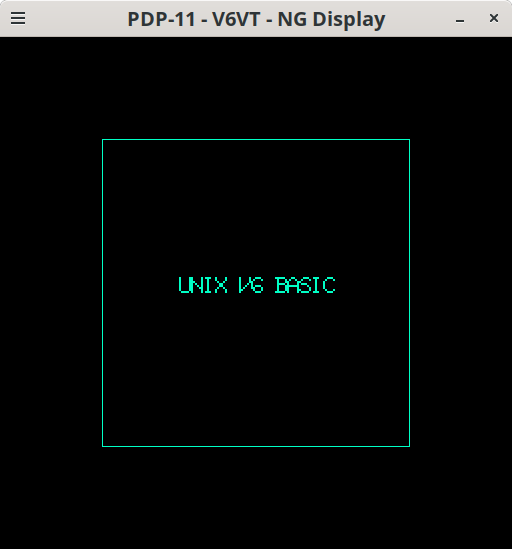
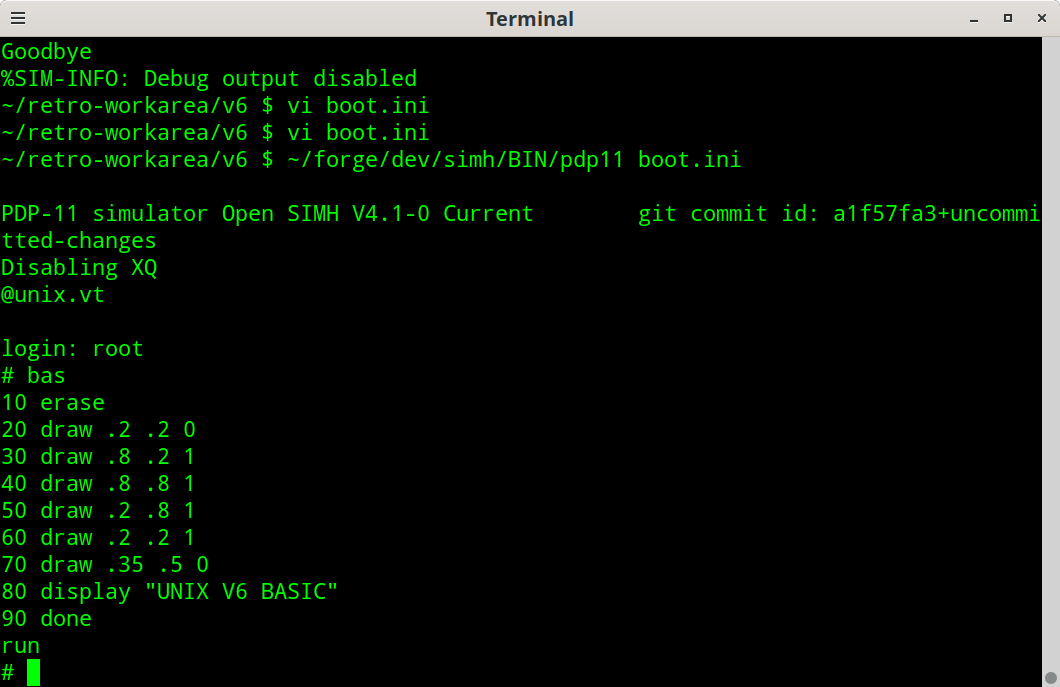
to work on a basic v6 instance running bas, the v6 version of BASIC:
Background
Lately, my interests have revolved around language design. I wrote Aiki, pulled its heart out into Nezha, and in the process realized that I needed a deeper understanding of compilers and compiler design, and of how they came to be.
That led me to ALGOL 60 and the early compilers—or translators, as they were often called. I dug out my copies of the three Dragon Books and settled on the Green one for a deep dive into early techniques. In the process of reading and thinking about language translation, I realized that I should have a language in mind to compile.
Aiki has its appeal, but it is not a good first target. Nezha is small and constrained enough, but no, I thought, I want something more conventional. K&R C? Perhaps. V6 assembly? That has its appeal, that's for sure. I heart V6.
So I logged in to see what other candidates it might offer up and found SNOBOL, and then
bas—V6 BASIC.But BASIC, really? Surely this was just a sad little implementation of BASIC for V6 that didn't even do graphics.
I pulled up the source with little hope, and then saw: wait a minute. It does do graphics?
Nothing in V6 does graphics.
But there it was.
The V6 BASIC source contains
draw,erase, anddisplay, and writes its graphics output to/dev/vt0. The corresponding kernel driver is still present in/usr/sys/dmr/vt.cand identifies itself as:VT01 driver via DR11C to 11/20At that point the compiler investigation became a hardware reconstruction problem.
-
os dec pdp-11 emulators retro-computing
Getting DOS-11 V004A Running on a PDP-11/40
Getting DOS-11 V004A Running on a PDP-11/40
I did not set out to install DOS-11.
I have been working with Sixth Edition UNIX on a simulated PDP-11/40, partly to understand the system itself and partly to get closer to the environment described by Lions. That inevitably led downward. Reading the V6 source means reading PDP-11 assembly, and reading PDP-11 assembly means spending some time with the tools and conventions that existed around the machine before and alongside UNIX.
That led me to PAL-11R, DEC's relocatable assembler for the PDP-11, and from there to DOS-11.
-
unix research-unix v6 dec pdp-11
Lions Laboratory: A Sixth Edition UNIX Laboratory for OpenSIMH
As a follow-up to my note on setting up a Sixth Edition UNIX laboratory in OpenSIMH, I have now put the complete laboratory repository on GitHub:
The repository contains the V6 distribution materials, OpenSIMH configurations, PDP-11/40 and peripheral documentation, known-good system checkpoints, and the working notes I have accumulated while reading Lions and experimenting with the system.
-
dec emulators retro-computing lisp
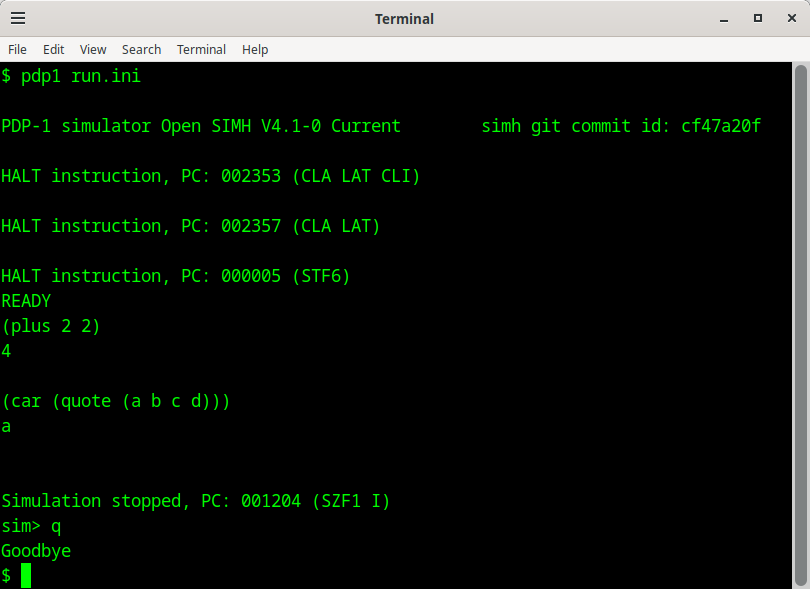
pdp1-lisp running on an emulated PDP-1
This note describes how to set up and run PDP-1 lisp. It's a pretty brief walkthrough. If you run into any issues, let me know.
-
unix research-unix v6 dec pdp-11
Installing and Using Unix V6 in the Open SIMH PDP-11 Emulator
This note details the process of building a working v6 instance from a copy of the original tape distribution. The v6 instance runs in a virtual PDP-11/40 provided by OpenSIMH, a masterwork emulator.
-
os dec pdp-11 rt-11 assembly
A tutorial introduction to programming PDP-11 Macro-11 Assembly in RT-11 v5.3
A tutorial about how to do assembly language programming and debugging in RT-11v5.3 running on a SimH PDP-11.
-
dec pdp-11 rt-11 assembly mac
Quick Setup RT-11v5.3 (Mac/Linux)
A quick start note for getting up and running with RT-11v5.3 on PDP-11 with little to no fuss.
see Tutorial - Setting up RT-11 v5.3 on SimH PDP-11 (Dec 30, 2015) for a more verbose version.
-
os dec pdp-11 rt-11 emulators
Tutorial - Setting up RT-11 v5.3 on SimH PDP-11
A tutorial about how to set up an RT-11 v5.3 in a SimH PDP-11 instance in Support of MACRO-11 Assembly Development and Experimentation.
The RT-11 is a small, single-user, real-time operating system for the PDP-11, 16-bit family of computers. It is simple to install and it works fine with SimH, it just takes some getting used to. If you have ever used DOS, it will seem mildly familiar. This tutorial is enough to get you started with RT-11, but it is by no means a complete introduction. Once you have the environment up and running, I recommend that you read Introduction to RT-11 referenced below. That document will take the reader through a number of exercises to get more familiar with the operating system.
-
dec pdp-11
PDP-11 BASIC, booting the hard way
This note describes the process of running PDP-11 Basic from the PDP-11 Basic Paper Tape System. It is informed and inspired by Malcolm Macleod's webpage entitled, "PDP-11 Paper Tape BASIC" located at http://www.avitech.com.au/ptb/ptb.html. It describes the process, step by step, of keying in the bootstrap loader, running it to load the absolute loader from paper tape stored in bootstrap loader format, and then running the absolute loader to load the PDP-11 BASIC program from paper tape stored in absolute loader format.
To learn more about how the bootstrap loader works, see my prior note