development
-
development scheme ucb-stk
UCB STk Scheme Interpreter for Working Through Brian Harvey's CS61A Course
This note describes how to install the UCB STk 4.0.1 Scheme interpreter on modern 64 bit Debian based systems. It also describes a method of building the Debian Package used to install the program. This is the version of scheme used by Brian Harvey in his 2011 course, CS61A: Structure and Interpretation of Computer Programs, named after and using famed text, Structure and Interpretation of Computer Programs by Harold Abelson and Gerald Jay Sussman with Julie Sussman, a phenomenally good computer science textbook.
Now, I'm not a package maintainer and I certainly don't know the nuances of building packages, this is just meant to document how I was able to get this working in 2023 after reading tons of "too bad, so sad, I can't get it to work posts", YMMV, but I've tested on LMDE5 (Elsie), Mint 21.1 (Vera), MX Linux 21.3 (Wildflower), and Ubuntu 22.04.2 (Jammy Jellyfish).
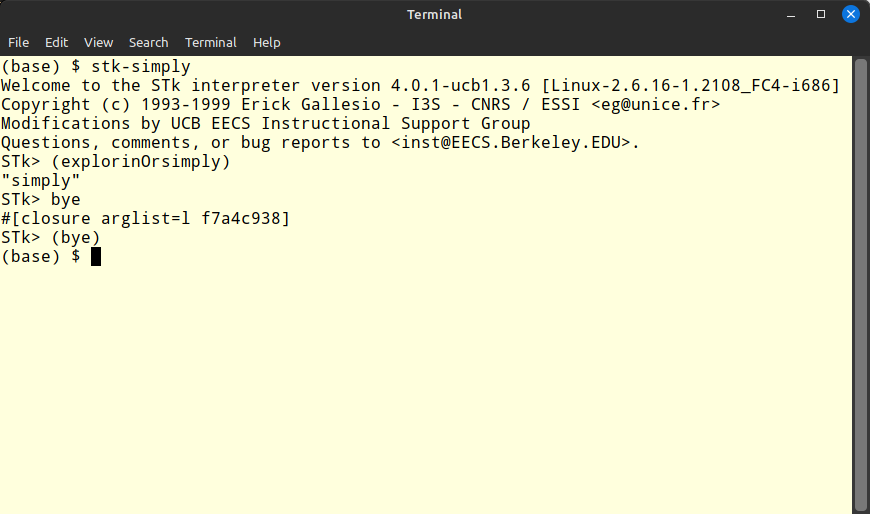
Here's a screenshot of the working system running on LMDE5:
-
development x-windows slackware15
Setting up Slackware 15 on T430 for X Window Programming
The note walks through the process of installing and configuring a working Slackware 15 64 instance with the packages mirrored locally for ease of access and eliminating the need to be online as much. When the system is up and running it provides xdm services to nearby hosts (those on the local network). This makes running and testing x window clients simpler and more interesting. You may notice that the note references other environments that you may not have or want to use (MacOS Mojave and FreeBSD 13.1). Just ignore those references as they are not strictly required.
I chose Slackware 15 64 as the environment after trying out various flavors of Debian, Arch, Kwort and others. While these worked ok, they did not provide much of a clean, vanilla x experience. Slackware, on the other hand, provided a sane, simple, and understandable x environment that was pretty vanilla :). It feels really good to get back to Slackware and its simplicity. I don't have a gazillion processes running doing who knows what, the laptop sleeps without crazy interventions, and stuff works well. That said, Slackware is not for the faint of heart. You should be somewhat familiar with Linux and it's command line interface and be willing to do your own research before jumping into it.
-
development x-windows xlib
Xlib basics
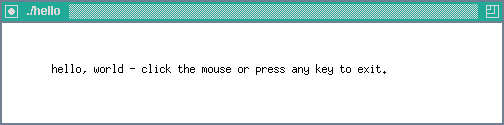
This note explores the basics of Xlib. It covers enough to open a window, configure it, display a message, respond to some events, and close it gracefully - see figure 1 for a hint at what this will look like.
Why xlib? Well, because we can, because it is the lowest level above the X protocol (sending bits around), and because, contrary to many espoused beliefs these days, knowing how to do something the 'hard way' helps you understand what's going on with the 'easy way'... and when things inevitably go wrong, you want to have a clue.
Figure 1. A Basic Xlib Application